Early raids load out
Early World War II British Commandos—formed in 1940 by order of Winston Churchill—were an elite raiding force intended to harass German-occupied Europe, gather intelligence, and destroy critical infrastructure. Their operations included notable raids such as Operation Collar, Operation Claymore, and Operation Archery.
Overview
These early commandos were lightly equipped to ensure speed and stealth. Their loadout was a combination of standard British Army gear, specialized weapons, and equipment tailored for amphibious raids.
Uniform
-
Denison Smock (early versions for some units by 1942, more common later): A camouflage smock designed for paratroopers and commandos.
-
Battledress Uniform: Wool service dress blouse and trousers; initially khaki, later olive drab.
-
Commando Boots: Hobnailed leather boots with reinforced soles, sometimes replaced with rubber-soled boots for stealth.
-
Wool Balaclava or Cap Comforter: For warmth and to help obscure identity.
-
Steel Helmet: Mk II helmet (similar to WWI design) or sometimes the "Turtle" Mk III helmet in later raids.
-
Belt and Webbing: 1937 Pattern Webbing—lightened from regular infantry configurations for mobility.
Weapons
Primary Weapons
-
Lee-Enfield No.4 Mk I Rifle (some carried earlier SMLE Mk III): Standard British bolt-action rifle.
-
Sten Gun Mk II: 9mm submachine gun; compact and ideal for close quarters.
-
Thompson M1928A1 SMG: .45 caliber, used early on via Lend-Lease, known for power and reliability.
-
Lewis Gun: Early raids used these light machine guns for fire support.
-
Bren Gun: More common from 1941 onward, replacing the Lewis Gun.
Sidearms
-
Webley Mk VI Revolver: .455 caliber, standard issue.
-
Enfield No. 2 Revolver: Also in service.


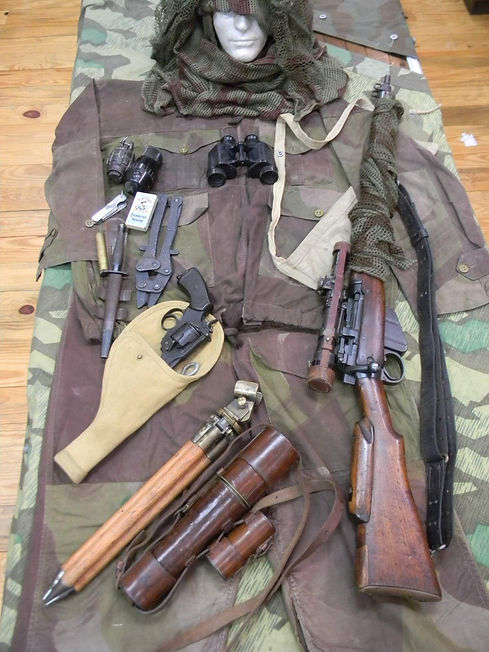
Explosives and Special Equipment
-
Mills Bombs: Standard-issue hand grenades.
-
Gammon Bombs: Improvised anti-tank/anti-material grenades, filled with plastic explosive.
-
Limpet Mines: Magnetic mines used for sabotage of enemy ships and infrastructure.
-
Time pencils: Delayed-action fuses for sabotage charges.
-
Plastic Explosives: For bridge and railway demolition.
Tools and Specialist Gear
-
Wire Cutters
-
Climbing Ropes
-
Flashlights (torches): Covered with blue or red filters to avoid detection.
-
Signal Mirrors
-
Compasses and Maps: Often carried in a waterproof case.
-
Binoculars
-
Silencers/Suppressed Weapons: Very limited and experimental; Welrod pistols and suppressed Stens appeared later in the war.
Carried Equipment (Backpack/Assault Pack)
-
Lightweight Rucksack or Bergen (early styles based on Norwegian designs).
-
Rations: Emergency rations (bully beef, hardtack, chocolate, tea).
-
Water Bottle: 1937-pattern with enamel or aluminum flask.
-
Entrenching Tool: Often carried for digging or breaking cover.
-
First Aid Kit: Individual field dressing, morphine syrette in some cases.
Transport and Infiltration Tools
-
Folding Boats (Folbots/Kayaks): Used by units like the Special Boat Section (SBS).
-
Assault Boats: Inflatable or wooden, used in landings.
-
Climbing Spikes: For scaling cliffs or harbor walls.
-
Blackened Faces and Camouflage Paint: To conceal facial features in night operations.
Communication Equipment
-
SCR-300 or WS No. 18 Wireless Sets: Occasionally carried for long-range communication (bulky, battery-powered).
-
Signal Flares: For extraction or coordination.
Summary of a Typical Early Commando Loadout:
ItemExample
Primary WeaponSten Gun Mk II or Lee-Enfield Rifle
SidearmWebley Revolver
ExplosivesMills Bombs, plastic explosives, limpet mines
UniformBattledress with Denison Smock (later), commando boots
Webbing1937 Pattern Webbing (modified)
PackLightweight Bergen with rations and tools
ToolsWire cutters, ropes, compass, torch
CommsFlares, basic radios (occasionally)
Specialty GearCamouflage paint, climbing tools
Notes on Operational Doctrine
-
Speed and surprise were paramount. Commandos trained in hand-to-hand combat, small-unit tactics, and demolitions.
-
Units were often self-sustaining for 24–48 hours—raids were short, with fast exfiltration.
-
Their gear reflected a blend of infantry utility and raider flexibility—less encumbered than regular troops.
Would you like a loadout diagram or illustrations of these items?