Combined Operations
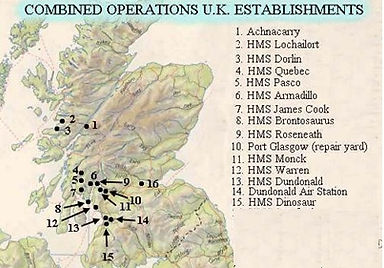
Combined Operations training in Scotland during World War II was a crucial part of Allied efforts to develop and perfect amphibious warfare tactics that would be used in major operations such as the D-Day landings in Normandy. Scotland's rugged coastline, remote terrain, and relative safety from German attacks made it an ideal location for intensive and innovative military training.
Scotland served as a vital cradle for the development of modern amphibious warfare during World War II. The Combined Operations training conducted there forged some of the most skilled and versatile units in the Allied forces. With its challenging terrain, extensive coastlines, and relative safety, Scotland provided the perfect natural classroom for the evolution of joint military strategy that proved pivotal in the eventual Allied victory.



Background and Purpose
Combined Operations was a term used to describe joint military actions involving different branches of the armed forces—primarily the Royal Navy, the British Army, and the Royal Air Force. The goal was to create highly coordinated operations where land, sea, and air units worked together to execute complex amphibious assaults. As the war progressed, the necessity for such operations became increasingly apparent, especially in planning large-scale invasions of enemy-occupied territory.
Key Training Locations in Scotland
Several strategically chosen sites across Scotland became centers for Combined Operations training:
-
Inveraray (Loch Fyne)
-
The Combined Operations Training Centre (COTC) was established here in 1940.
-
Inveraray became the principal location for theoretical and practical training in amphibious operations.
-
Troops learned beach landings, small boat handling, signals coordination, and naval gunfire support.
-
-
Achnacarry (Commando Training Centre)
-
Located in the Highlands near Fort William, this was the primary training depot for British Commandos.
-
Recruits underwent grueling physical training, assault courses, weapons practice, and mock raids.
-
The harsh landscape was ideal for conditioning elite troops for behind-enemy-lines missions.
-
-
Lochaber and Arisaig
-
These areas were used for mountain warfare and sabotage training, particularly by Special Operations Executive (SOE) and Commandos.
-
Realistic demolitions and guerrilla tactics were taught in secluded environments.
-
-
Portpatrick and Cairnryan
-
Coastal towns used for beach landing practices, including trials with landing craft (LCAs and LCTs).
-
Naval and army units coordinated timing, disembarkation procedures, and beachhead securing.
-
-
Loch Ewe and Scapa Flow
-
Naval bases used for convoy escort training, refueling, and logistical coordination.
-
Also served as embarkation points for some assault forces later in the war.
-